 |
| Dior New Look jacket and dress from 1950 |
The ubiquitous jacket has been worn by children and pensioners, hip-hop artists and ballet dancers, fashion editors and nuns. It is often seen dressed up as often as it is dressed down. As easily worn with a matching Chanel skirt as it is with frayed faded jeans.
One of the jackets ultimate selling points therefore is its versatility – versatility being something inherent to the philosophy of the
little black jacket’s creator, Coco Chanel. With the design dating back
to the early 50s, the boxy shape was strikingly different to the
cinched-in waist of the post-war New Look fashion of the time – the look propagated by Christian Dior.
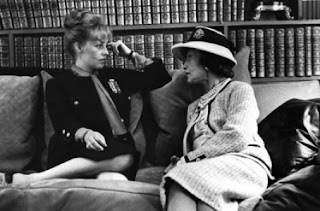 |
| Coco Chanel and Jeanne Moreau in Chanel skirt suits with her signature boxy jacket, 1960 |
To ensure the jacket always hung well, a brass chain was positioned
around its bottom hem. This was then neatly concealed by the silk lining. ‘My jackets look just as good inside as out,’ Coco Chanel would often
proclaim. Believing that each design feature should fulfil a function,
she added pockets that women could put their hands in — something only
done by men at that time. Similarly, the buttonholes were such that the jacket could actually be buttoned up and unbuttoned as desired, for comfort.
The use of braid emphasised the jacket line, pocket edges and cuffs.
The visual impact of the piece was enhanced by trimming it with
petersham ribbon, looped braid or countless other variations, which were
sometimes cut or even sewn directly onto the selvedge to achieve an ‘unfinished’ fringe effect.
 |
| Worn by Jane Birkin with faded denim |
|
Boxy, structured and capable of being buttoned top to bottom, the
garment’s elegance lies in the freedom of movement it allows — no
shoulder pads, no bust darts and only a single centre seam in the back. Writing in her biography of Chanel, Justine Picardie describes it as an example of how the designer was paving a ‘way of dressing that was masculine in its unruffled dignity, while remaining true to its creator's idea of femininity’. Chanel’s boxy cut allowed for movement, was less restrictive, but was still incredibly flattering to the female silhouette without clinging to it. Along with Paul Poiret, Chanel was credited with liberating women from the constraints of the ‘corseted silhouette’ and popularizing the acceptance of a sportive, casual chic as the feminine standard in the post-World War I era. This jacket, Picardie argues, showed she actually wasn’t very interested in fashion. Instead, as her much-quoted adage ‘fashion passes, style remains’ implies, she wanted to create clothes that could be worn for ever – clothes that would never date.
 |
| The versatility of the Little Black Jacket |
|
|
Lagerfeld, when head of Chanel, deformalised it by restructuring the skirt suit, playing with the shape and continuously altering it during his reign as head of the design house. Interpretations have included Claudia Schiffer's famous turn on the runway in a 90's leather miniskirted version, while previously the gregarious 80s had seen a power shouldered interpretation. The jacket has evolved to take on every guise that each decade has thrown at it. More current visions have included grungy fraying and cropped shapes on recent runways.
 |
| Kanye West does his take on the Little Black Jacket, by Lagerfeld |
Lagerfeld’s reinvention of her famous jacket then, would appear to have fitted very much into her ethos.
Taking over at the brand in 1982, 11 years after Coco’s death, he
revitalised a fashion house that had become a stalwart of the twinset and pearl brigade into something that was once again fresh and modern, yet with the archive still central to its image. Coco staples such as pearls, quilting,
the camelia, the little black dress, monochrome and, of course, the jacket are part of the Chanel heritage that he continues to return to again and again for his new collections. When Lagerfeld stepped into Coco’s design shoes, the fashion house’s image was inextricably entwined with the potent image of a certain type of ‘lady who lunches’.
 |
| A child wears the Little Black Jacket, by Lagerfeld | |
|
  |
| Vanessa Paradis dresses down her Chanel tweed jacket with blue jeans |
This constant reinterpretation and reimagining of Chanel’s stalwart ‘symbols’ is a strategy that appears to be working. Certain iconic images – the bag, the pearls, the LBD, the tweed jacket, have become so ingrained as markers of style and luxury that we have now reached a stage where we can imbue them with post-modern sensibilities. You can grungify a Chanel jacket and make it cool – the delicate pearls can be magnified to enormous balls and become playful and young. Because the pieces are so iconic and so recongnisable, they allow us to make a post-modern take on them and make them ‘cool’.
If, in Coco's day, Jackie Kennedy (t
he twee pink bouclé suit she wore in Dallas on November 22, 1963 when her husband was assassinated has become a part of history – although Lagerfeld reveals in the book of the exhibition that it was in fact a fake, ‘a line by line copy by [Oleg] Cassini’) and Wallis Simpson were Chanel ambassadors, a Chanel jacket is now in the wardrobe of equivalent much copied fashion icons from Alexa Chung to Beyoncé to Vanessa Paradis to Keira Knightley.
 |
| Actress Rachel Bilson in her Chanel jacket |
For film director Sofia Coppola, the jacket ‘is a classic that goes
with everything. You can wear it anytime, day or night, casual or
dressy.’ Actress Kirsten Dunst says the jacket represents comfortable elegance and is the first real blazer for women. ‘You can throw on a Chanel jacket with anything and look good. When you own something of this luxury you don’t give it away, you pass it down to the next generation,’ she says.
For Japanese actress Rinko Kikuchi who shot to fame in the movie
Babel, the jacket celebrates both independence and fragility. ‘The little black jacket survives the ages because of its simplicity and versatility. I can wear it with formal attire and change into jeans after the party,’ she says.
 |
| Actress Diane Kruger in an embellished version of the Chanel Little Black Jacket |
For Karl Lagerfeld, Coco Chanel’s
legacy remained one of the classics in the industry. ‘Some things never go out of fashion: jeans, the white shirt and the Chanel jacket,’ he said.
 |
| Victoria Beckham in her Chanel Little Black Jacket |
Whereas it was movie stars such as Gwynneth Paltrow who began wearing the jacket with jeans in the early 90s, showcasing a new take on how to wear the jacket. Today, it’s fashion icons such as Alexa Chung who often collaborates with Lagerfeld and serves as an ambassador for the brand. The jacket has moved from Gwynneth’s world of privilege and 5th Avenue princess, to an edgier, funkier, more fashion led world. Alexa’s tomboysih style mirrors even that of Coco Chanel, and she appears to enjoy playing with the jacket’s iconic
status – demonstrating its incredible versatility as both a high fashion upscale staple, to a more irreverant post-modern statement piece. She wears the Chanel little black jacket one day with a kooky prim hairband and skirt as a nod to Chanel’s prim heritage, and on another day with no skirt at all and suspenders on show.
 |
| Kate Moss has showcased the jacket in an assortment of colours |
As a result, in the past few years the boxy tweed jacket has infiltrated the high street with
affordable copies by stores such as
Zara and
Mango becoming bestsellers for
those who appreciate the style and versatility of the jacket, but can’t
afford the designer price tag.
 |
| Alexa Chung incorporates a Chanel Little Black Jacket into her own modern, quirky style wearing it (below) with just a shirt and suspenders |
|
|
|
Coco was, however, her own best advertisement.
She wore her trademark jacket well into her old age. While the
French brand might, in most people’s heads, be associated with that
trademark double-C logo, pearls and quilted bags, the little black jacket is another classic well worth its place in fashion history.


