Showing posts with label 1960s fashion. Show all posts

Saturday, 27 November 2021

Peter Jackson Beatles Docuseries 'Get Back' is a Fashion Feast for the Eyes

 Like millions of other Beatles fans across the universe, I have just spent three consecutive nights watching Peter Jackson's 8 hour, three part series of the 1969 'Let It Be' sessions -a  paean to what some consider the greatest band ever. It is undoubtedly a love letter to his favourite group. Peter Jackson stated that he would never have involved himself in such a massive undertaking (he reviewed over 60 hours of original director, Michael Lindsay-Hogg's original footage and whittled it down to 8 hours) for any other band. Indeed he stated that the Beatles are the only music he ever listens to. Get Back is an intimate portrait of a band in the twilight days of their career as a group. It is a fascinating historical document even if you don't like the Beatles (although it does 'Help!)


The Beatles during 'Let It Be' recording


'Get Back' is a fascinating watch for any Beatles fan, music fan or lover of the 1960s. I'll admit there were moments when my mind began to wonder, Paul's fortieth rendition of the first line from 'Get Back' as he tries to find a rhyme for 'last, really takes you into the songwriting process and the mind of a master craftsman as he creates a musical masterpiece. Some of the songs we are privy to - John's 'Child of Nature' became 'Jealous Guy' were years in the making - more than 10 in some cases. And the drudgery that can be the process of songwriting when you are both a genius and a perfectionist are clearly apparent - repeating the same line over and over until you get the perfect follow up rhyme sometimes make you want to shout what you now know to be the next line, through the screen.


But one thing that was always a treat was the feast for the eyes that were the Beatles outfits. When it came to the fashion stakes, every Beatle, even the generally more conservative Paul, brought their end-of-the-sixties, fashion A game to the studio. I have already written on how John Lennon is my personal favourite 'Best dressed Beatle'. His outfits were always perfectly conceived and put together, without looking too overstyled. However, in Get Back, it is George Harrison who kicks all his bandmates off the catwalk, with some incredible magenta hued 'fits and a shaggy black coat noughties Kate Moss would die for. Ringo trails behind George mastering 60s loud and funky, John gives off insouciant laid back cool, and Paul wears some cool shoes.


George Harrison looking fly on the roof of Apple Corps

When Brian Epstein first conceived their image back in 1962 - the band went from bad boy greased back hair and leathers, to the matching maharishi neck suits, shirts, ties, cuban heeled boots and of course, the famed mop top hairstyle that we think of when we think of early Beatles fashion. Even when they grew their hair and sported facial hair and beards in their later years, they still sported matching suits for promotional material (such as the famous satin military style suits in garish pinks and oranges worn on the Sgt Peppers album cover.


After Brian Epstein's untimely death however, in August 1967, the Fab Four dropped the matching suits and hair and opted for a look suited more to their individual personalities. As John suggests at one point in the documentary, Brian was the glue that held the four together - without him they seemed somewhat lost at sea, unable to overcome their egos, and unable to put aside their differences in order to unite for the common good. We watch as they descend into petty squabbles as their huge personalities clash, with members vying to be heard over the extraordinary talent in the room. George Harrison entering the studio one morning and quietly mentioning to Paul and John that he'd made up a little tune the night before whilst watching TV felt like a little brother shyly proferring his idea to his big brothers. Except the tune was George's incredible 'I Me My'. That each member was moving in his own direction and each members dissatisfaction in the group dynamic is very apparent as the documentary. The moving in different directions is mirrored in their choice of outfit and individual style, as well as the mental shift going on.


The Beatles as styled by Brian Epstein

In the 'Let It Be' sessions, the Beatles sport some incredible outfits. From a fashion standpoint it's fabulous to see late 60s men's fashions living and breathing on some of the most famous young men of the day in their everyday lives. The clothes and hairstyles all appear strikingly modern - partly a testament to Peter Jackson's incredible remastering of the footage making it look like it was filmed last week and partly to do with the fact that cool vintage fashion never really looks outdated if worn right. Get Back is like a 60s men's runway show with groovy outfit after groovy outfit. Harry Styles probably watched it twice - once for the music, and once to take notes on the great fashion.


The Beatles wives also deserve a mention. Maureen Starkey, Ringo Starr's wife, appears briefly looking like the fourth Ronette with her huge black bouffant, winged black eyeliner. mini skirt and gogo boots combo. A masterclass in 60s fashion chic. Yoko Ono is present throughout the documentary, barely leaving John's side, although she also hardly speaks (wholly contradicting the image Lindsay-Hogg's version of the sessions presents of her as the meddling harridan who broke up the the greatest band of all time.) In Jackson's version, Yoko is all but silent, (it's worth noting however, that she was one of the executive producers on Jackson's version, which may go some way to explaining this image of 'likeable Yoko' here), other than to to join in on vocals while playing around with the band while they are de-stressing between recordings. Yoko pretty much spends the 8 hours sitting around looking cool. Perhaps her best outfit is in Episode 2 where she wears an all black plastic/PVC outfit and wide brimmed black floppy hat. Very New York bohemian late 60s cool.


Yoko Ono playing around between sessions

As mentioned, in these sessions, of the Beatles themselves, it is George who makes the most interesting fashion choices. In the first scene of the first episode he walks in wearing his massive shaggy black Mongolian lamb fur coat over a denim shirt, marrying his love of all things Eastern and mystical with classic American denim. Then on day two he steps into the studio wearing a bubblegum pink turtleneck sweater (he has the same one in Mean Mr Mustard yellow). Perhaps my favourite George look is his Austin Powers baby pink striped flared suit which he tones down by wearing with black converse style tennis shoes and shaggy hair. It's a look. I was always under the impression that the 'battered tennis shoes and suit' combination was a 90s thing, worn by Britpopers and nearly every character at some point in Danny Boyle's 'Trainspotting'. But 'Get Back' has George Harrison sporting the look a whole thirty years earlier. John Lennon wears a similar look, this time with battered white plimpsolls, also in 'Get Back'.


George Harrison in his pink striped suit

At one point in the docuseries, George is sent a delivery of a purple velvet bow tie - very kitsch - he immediately unboxes it and promptly put it on around his neck - under his shirt  - wearing it around his neck like a choker, thus proving that style isn't just the clothes you wear, but how you choose to wear them.


Paul has always had the reputation - somewhat unfairly - of being the least interesting Beatle. The documentary shows he is clearly the most driven and business-minded of the band. Clothing-wise, he wears some interesting pieces - giving off some 'cool dad' vibles. A fluffy orange jumper springs to mind, and a starry black shirt. The midnight blue velvet jacket he wears on the famous concert on the roof scene is a classic. And there's a great pair of 60s brown leather lace ups with a studded detail that he wears throughout. 


Paul in his orange fluffy jumper

As for John Lennon - some have suggested that his 'Let It Be' days were not his strongest sartorially speaking. However, for me, every outfit he wears during the documentary, is a 'look'. His all white outfit  - drainpipe trousers and t-shirt with dirty plimpsols and a waistcoat looks really 'summer of 69' and his rooftop look of round glasses, shaggy fox fur coat (borrowed from Yoko) black poloneck, skinny black jeans and those dirty plimpsols again looks like something Margot Tenenbaum would wear. Along with a plethora of brightly coloured skinny fit long sleeve Henley t-shirts John Lennon's look is probably the most transferable to today. Swap the real fur for faux and I would love to have his wardrobe.


John Lennon on the rooftop of Apple Corps

Lastly, of the Beatles, is Ringo and his many shirts of many colours. From floral pink to paisley to acid green frill fronted to red satin and polka dot, Ringo's selection of shirts is a riot of psychedelic colours - an explosion in a kaleidescope factory. One of the highlights of the series is guessing what colour shirt Ringo will wear next.
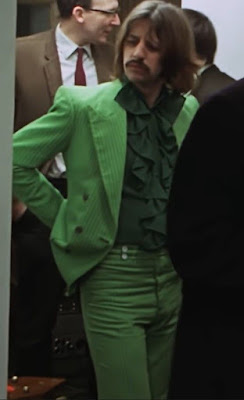

Ringo giving Austin Powers a run for his money

When Peter Jackson decided to make his docuseries he clearly never intended to make a fashion film, but when he was granted access to the famed footage from January of 1969 he opened a portal into an incredible time capsule. The 1960s fashion featured in the series is a vintage lover's gold mine and yet also so modern at the same time. Have a watch and be inspired.

Monday, 9 August 2021

Is the 60s the Greatest Fashion Decade of the last 100 years?

Andy Warhol, Edie Sedgwick and Chuck Wein, 1965

 In the same way that current young people are looking back to the 90s and early Y2k for their fashion inspiration, (the 80s have been done and dusted apparently) in the 90s we looked back to the 60s and 70s for our sartorial influences. Does fashion travel in 20-30 year cycles? So it would seem. But what rich pickings those two decades were! To this day, the fashion of the 60s and 70s will always have that fashion edge for me. Children of the 60s were just stepping out of the drudgery of a post war society with it's bombed out buildings, rationing (including fabric) and misery, to a more affluent and exciting future. Music was at it's most creative, as was cinema - in fact every area of the arts. Think the Beatles, The Rolling Stones, The Doors, Motown, Phil Spector and his girl groups. The birth of independent cinema was well underway with the French wave, Luis Bunuel and Ingmar Bergman on this side of the Atlantic and John Cassavetes, Stanley Kubrick and Sidney Lumet making waves in the States. In the art world, Andy Warhol and his Factory were creating his famous Pop Art, and in the world of fashion - where to start?

The Ronettes, early 1960s

Although some might see 60s fashion as somewhat twee or overdone - from caricature images of paisley-wearing Hippies carrying flowers, to men in capes or cartoon-colourful silk jackets a la the Beatles on the cover of Sargent Peppers. With women in white go-go boots, Mary Quant dresses and ridiculously thick lashes and PVC baker boy hats - it's easy to dismiss the 60s fashion as fancy dress clothing that doesn't translate. 

The Beatles in their Sgt Pepper's gear

But perhaps no other decade made such a marked and startling transition from it's predecessor than the 60s from the 50s. And this is one of the reasons why the 60s holds such a strong place in the hearts of many a fashion lover. It was a truly groundbreaking decade in so many ways. In previous decades, fashion was aimed at an older market. The 60s for the first time truly embraced styling for the younger generation. For once, dressing like your parents was not what teenagers aspired to (think of all those old photos of your 15 year old grandparents where the boys wore suits and ties and looked like they were in their 30s). This time, teenagers were given the option to dress like teenagers. For the first time fashion was driven by the youth market -the term for it - the 'youthquake' was coined by Vogue editor Diana Vreeland, to highlight the moment that the idea of the post-war teenager really came to life.

Mary Quant

So what was the 'youthquake'? it was the rebellion marked of not dressing like your parents. Without the 60s youthquake, there would be no punks or indie-kids or goths or emos. The teenagers of the 60s shunned the couture houses of their parents, and made Carnaby Street and the boutiques of the Kings Road, the centre of the fashion universe. This mini revolutiuon against tradition and confinement changed the course of youth and fasfhion culture forever. Teenagers embraced psychedelic prints, shift dresses, PVC, Mary Quant Mini skirts, faux fur, pant-suits and colour pop tights. (although mini skirts were de rigeur, going bare-legged was still considered immodest).

Hippies

Fashion trends mirrored social movements of the time. The Hippies being the most obvious. The subculture which embraced free-love, mind-expansion through drugs, meditation, exploring the world through travel, and a liberal, anti-war stance was translated into their clothing aesthetic. Their rejection of consumerism led to a more individualistic approach to fashion. Bell-bottoms, tie-dye, long hair and beards, armfuls of Indian silver jewellery, organic materials, bright, swirling colours and flower-power. This move into fantastical, magical dressing would never have been believed by those living a decade earlier. 

The women's liberation movement was in full-swing, the pill meant free-love was possible without the fear of pregnancy and in a pre-Aids world there was an experimental innocence to the movement. The 60s 'Single Girl' was based on Helen Gurley Brown's 1962 book 'Sex and the Single Girl' which showed women as financially emotionally and sexually independent. Fashion and fashion photography created a new feminine aesthetic, which was thin, 'active', self-reliant, and liberated. 

The Single Girl, as highlighted by Cosmo

For the first time women were also showing off more skin, the shortest of mini skirts, bikinis, hot pants, camisole vests all had their birth or were popularised in the 1960s. Women's silhouettes also changed to match the clothes - skinny, boyish figures were the order of the day and pushed out the curvy, womanly frame of the 1950s. It was as if all this skin on show required a more boyish figure to make it less 'shocking' to people's sensibilities. A cultural revolution was taking place for women, but in order to make it more palatable to the masses, it had to be watered down. Women could show off their bodies - but cleavage and hips were out and a more streamlined look was in. The voluptuous screen sirens of the 50s - Marilyn Monroe, Jane Russell,  Sophia Loren, Jayne Mansfield - gave way to the likes of Twiggy, Jean Shrimpton, Verushka, and Penelope Tree, who all embodied a big eyed, skinny limbed child-like aesthetic. 

Twiggy

The old adage about 'starving in times of plenty' was most certainly true for the 60s woman. As the West came out of the Second World War, rationing went on in the UK til the mid 1950s. The 60s were seen as a time of plenty - just like the 20s had been post-First World War, and women's body fashion shrunk with the abundance of food available. In an age of post-war affluence, rising body weights and changing fashions, dieting and eating disorders became an unfortunate secondary effect amongst young women. The feminine body has always served as a symbol of socially created values, and in this case, the long-limbed, pre-pubescent aesthetic of the 60s illustrated how women were 'permitted' to be more autonomous while still paradoxically, being put in a box of pre-conceived ideas.

Mods on their scooters

Although the Hippies are undoubtedly the most famous image of the 60s, other countercultures are equally significant and influential. The Mods, 'Modernists' who first appeared in the late 50s were a working class movement focused around French and Italian style - think sharp skinny suits and polo shirts whilst riding around on Vespas or Lambrettas. They listened to Black American soul, ska and R&B and were all about looking sharp, whatever the budget. Their rivals, the 'Rockers' considered them effeminate and preening, however, their cool and attention to detail made their look one that is copied to this day. Other subcultures included Rudeboys, Rockers, Black Panthers and more.

Jackie O's 60s chic

The space race had a huge impact on aesthetics. Andres Courreges SS64 collection debuted the "space style," which featured trouser suits, goggles, box-shaped dresses with high skirts, and go-go boots. In the 1960s, go-go boots were a hallmark of go-go girl attire. The vivid hues, gleaming material, and sequins were all hallmarks of the look. Boxy forms, thigh-length hemlines, and flamboyant embellishments characterised the space age aesthetic. Designers of the space era favoured synthetic materials as well. Pierre Cardin created clothes with a plastic feel and strong forms. Non-cloth materials like polyester and PVC have also gained popularity in apparel and accessories. 

Andres Courreges SS64

Short plastic raincoats, colourful swing coats, and other daytime clothing were favoured by young women, who wore bubble dresses, helmet-like headgear, and coloured faux furs. The Nehru jacket first appeared on the fashion landscape in 1966, and it was worn by both men and women. Suits came in a wide range of colours, but they were all tailored and thin for the first time. Women's waistlines were left untouched, while hemlines became shorter and shorter. Low-heeled sandals and kitten-heeled pumps, as well as the popular white go-go boots, were among the footwear options for ladies. 

Pierre Cardin was most known for his helmets, short tunics, and goggles. He was famous for his "12 Unwearable Dresses in Contemporary Mater" collection from 1966 which used chain-mail, aluminium and plastic. Vinyl go-go boots, huge bouffant hair and silver mini dresses were all highlights of the fashion in the classic Roger Vadim movie Barbarella, where Jane Fonda demonstrated the space age look to perfect effect.

Marianne Faithfull and Anita Pallenberg

Then there is the rock star styling of the day - singers, actresses and models like Anita Pallenberg, Marianne Faithfull, Edie Sedgewick, Sharon Tate, who combined the best fashions that the 60s offered and rolled them into a creme de la creme of perfect 60s styling. The 'glamorous hippie', if you will - a look that combined mini shifts, go-go boots, shaggy fur coats, chandelier earrings and chain-mail dresses to name a few. It's a look that is most easily translated today - think Kate Moss and Alexa Chung in the Noughties in their fur coats, big sunglasses and fedoras - it's a look that screams Marianne Faithfull. In fact, Marianne Faithfull was so incensed at Kate Moss 'stealing her style' she publicly called her a 'vampire' and ended their friendship. Apparently imitation is not always the sincerest form of flattery.

Kate Moss Glastonbury 2005 looking very Anita Pallenberg

Ultimately, the 1960s can't be characterised by a single style, group, or aesthetic, which is part of what makes it so fascinating to look back on. Once you get past the tie-dye and countless Twiggy photos, you'll discover a lot more in what I consider to be the most fascinating fashion decade of the twentieth century.

Sunday, 7 March 2021

Who Were the Influencers of the 1960s?

 There’s no denying the 60s were one of the most stylish decades ever. There is a reason shows like Mad Men, Masters of Sex and The Marvellous Mrs. Maisel all make us want to hop into a time machine and steal the characters’ wardrobes (and furniture).

If buying into a certain prim look à la Dior was a big hit for 1950s fashion, the sartorial rule book was completely thrown out in swinging sixties. From Brigitte Bardot‘s beehive to Mary Quant’s geometric prints, every 1960s fashion icon contributed their own signature style to the decade (a theme that continued well into 1970s fashion and beyond). It was the era of the girl group, the gamine supermodel and the original IT-girls, who are still inspiring this generation’s Alexa Chung et al.

The sixties still provide designers of today with endless inspiration, from Hermès’ enduring Birkin bag (which FYI is a better investment than gold), to Dior’s feminist take on Edie Sedgwick’s Factory Girl style (and just look at the familiar trends popping up for SS18).

After a decade of cinched waists, full skirts and impeccable hair and makeup, many fashion traditions were broken in an act of rebellion, mirroring the momentous social and political changes of the decade. It was the era where no skirt was too short and no beehive too high. Today, we can thank the decade for culottes, geometric prints and boxy silhouettes.

From the sixties’ answer to street style stars to the key fashion designers, consider this everything you need to know about the style defining era.

Edie Sedgwick’s 1960s fashion

Edie Sedgwick and Andy Warhol

The wealthy socialite, toast of the New York art scene and a certain Andy Warhol’s muse, Edie Sedgwick was the original IT girl. The essential ingredients of her good-girl-gone-bad aesthetic were lashings of eyeliner, chandelier earrings, mini mod dresses with sheer black tights and a crop of platinum hair – one day to be celebrated by Sienna Miller in the film Factory Girl.Twiggy’s 1960s fashion

Twiggy's 1960s fashion

Twiggy in the 1960s

No 1960s fashion round-up would be complete without mentioning Twiggy, real name Lesley Hornby. Bob hairstyles were huge for 1920s fashion, but this girl cemented an even short hairstyle‘s place in history – the pixie crop. One of the greatest muses of all time, Twiggy quickly rose to supermodel fame, thanks to her paint ’em on thick eyelashes and the boyish style celebrity hairdresser Leonard chopped for her in ’66. Almost overnight she became the face of the decade; instantly recognisable, she’s been immortalised on everything from Andy Warhol screen prints to M&S shopping bags.

See more here